
Home · Competitive Tennis Coaching
Competitive Tennis Coaching in Northern Virginia.
One-on-one coaching for juniors chasing tournaments and school teams, and for adults playing USTA and club league. Coach Arun works on match patterns, decisions under pressure, and the mechanical leaks that quietly cost you close points. Private sessions are $90.
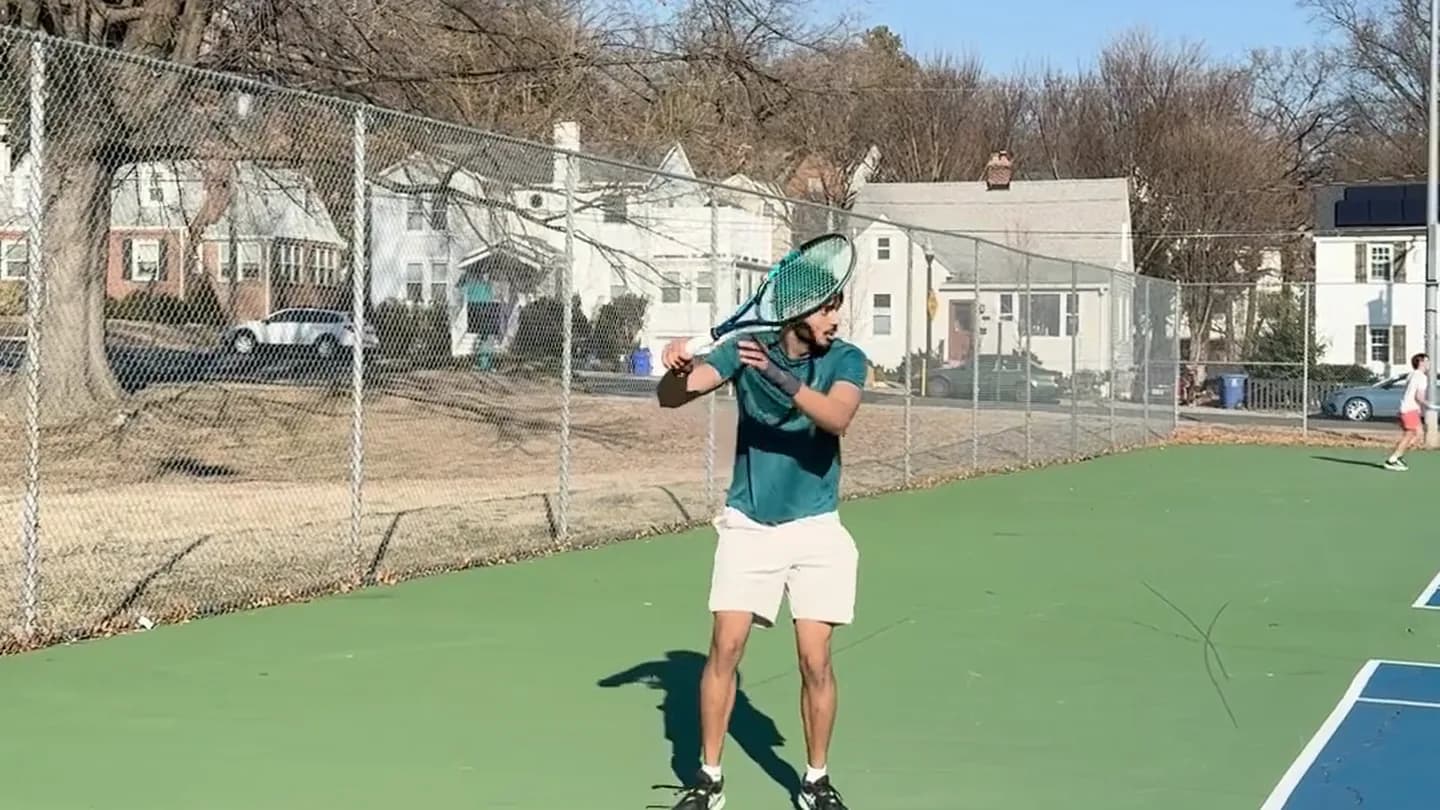
Who competitive coaching is actually for
Two kinds of players, and they need more of the same thing than you would expect. The first is a junior who has outgrown rec lessons: they can rally, they want to enter tournaments or make a school team, and the weekly group class has stopped moving them. The second is an adult in USTA or club league who trains fine, hits fine in warm-up, and keeps losing to people they should beat.
Both are stuck on the same thing. It's almost never effort, and at that level it's rarely raw technique either. It's a mechanical leak that only shows up when you are tired, or a pattern you can't see from inside the point.
Why good strokes fall apart in a real match
A stroke that works on a clean feed is not the same stroke you have at four all in the third. Under fatigue and nerves, the body reaches for whatever costs least, and if your power comes from the arm instead of the ground, that's the first thing to go. The shot doesn't get slightly worse. It changes shape entirely, and you start missing in a way you never do in practice.
I came to coaching through engineering and then a Master's in Sport Management, so I look at a stroke the way an engineer looks at a system. Where does the force start, where does it leak, and what will still hold when you're on your fifth match of the weekend. Fixing that is slower than a tip, and it's the only version that survives a scoreline.
Match patterns: the part almost nobody practices
Most players practice shots. Matches are decided by choices. Which ball to attack, which to reset, where to serve on a second serve you can't afford to miss, and what to do when the plan you came in with isn't working. These are learnable, and they move results faster than another month of stroke work.
The honest limit is that you can't see your own positioning while you are inside the point. That's what a coach is for. Bring me a match you lost and we will find where it actually went, usually somewhere you were not looking. For the tactical groundwork, the USTA league match play guide and the piece on court positioning cover a lot of it.
Juniors: tournaments, school teams, and the long build
Competitive junior work is a longer arc than parents usually expect, and the timeline matters more than any single lesson. We build movement and mechanics that will still be correct in three years, then layer competition on top. A junior who wins early with a technique that caps out at fifteen isn't ahead, they just got their progress early.
What that looks like in practice: footwork and contact quality first, then serve and return as real weapons, then patterns and match temperament. If you're working out where your kid sits in the local pathway, the junior tennis pathway in Northern Virginia lays out the levels. For younger or newer players, start at kids tennis lessons.
Adults in USTA and club league
League is a specific problem. You play a short season against many of the same opponents, matches turn on a handful of points, and your body has to survive a full schedule while you also work a job. So the work is targeted: the two or three patterns you can actually rely on, a serve you trust on the second ball, and enough movement efficiency that the third set feels like the first.
The mental side is real here too, and it's simpler than people make it. The last point is done. The next one is the only one you control. We build a small set of habits you can genuinely reach for when a match gets tight, rather than a philosophy you forget at deuce. More on the adult side at adult tennis lessons.
Plan this lesson near you
Choose your area for public court planning, local service details, and a request that matches this coaching format.
How competitive sessions are structured
Competitive work may use private coaching, live points, or a suitable training partner. The right format and cadence depend on the player's goals, schedule, and match load. See private tennis lessons for the one-on-one format.
The current service map includes Arlington, Falls Church, McLean, Vienna, Tysons, Alexandria, and Annandale. A court, day, and time are confirmed only after Arun reviews the request. See where lessons may be arranged and the pricing page.
FAQs about competitive tennis coaching in Northern Virginia
How is competitive coaching different from a regular lesson?
A regular lesson builds a stroke. Competitive coaching builds a stroke that survives a tight scoreline. We spend less time on clean feeds and more on patterns, decisions, and the specific mechanics that break down when you're tired or nervous.
Is my kid ready for competitive coaching?
If they can rally, serve to start a point, and they want to compete rather than just attend, they're ready. Wanting it matters more than level. I'll tell you honestly after one session if the timing is wrong.
Do you coach adults who play USTA league?
Yes. League play is its own puzzle: the same opponents each season, matches decided by a handful of points, and a body that has to hold up through a full schedule. We work on the patterns and the pressure, not just the strokes.
How often should a competitive player train?
Training frequency depends on the player's current schedule, match load, goals, and recovery. Share that context so Arun can recommend a cadence without promising a result or timeline.
Where do competitive sessions happen?
Flow State Tennis has no storefront. Send your area and schedule preferences, and Arun will confirm whether a suitable court, day, and time are available. A court listed on this site is a planning option, not a guaranteed lesson site.
What does competitive coaching cost?
Private sessions are $90, or $80 each when you purchase the current ten-session pack. Ask Arun to confirm the format and any other price before booking.
Ready to compete
Tell me what keeps costing you matches.
A junior going for tournaments, or a league adult stuck at the same level. Send your level, a match that got away, and schedule preferences.